
Frédéric de Bellaing I photographe
ARTICLE 23
Sans papiers, sans droits
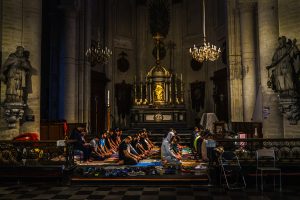
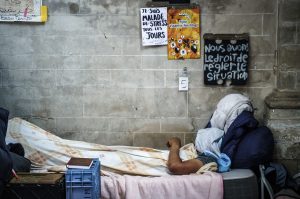
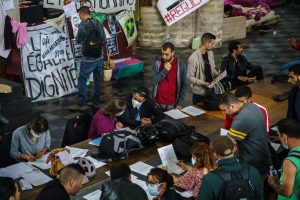
Occupation de l’église Saint-Jean-Baptiste au Béguinage par le collectif de l’USPR (et l’Union de Sans Papiers pour la Régularisation)
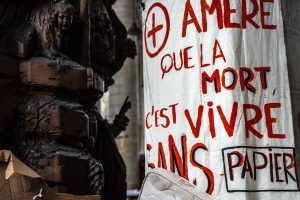
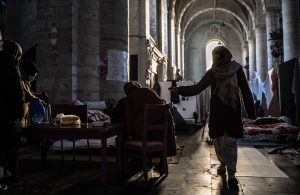
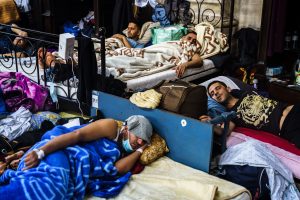
Le 31 janvier 2021, un groupe de plus de 250 sans papiers entame l’occupation de l’église saint jean-baptiste au béguinage qui au moment où j’écris ces lignes est toujours en cours. Ils s’y installent avec l’accord du père daniel. Ils demandent, entre autres, que des critères objectifs et clairs soient inscrits dans l’article «9bis». Cet article de loi stipule que pour «raisons exceptionnelles», une régularisation peut être accordée. Quant à ces raisons exceptionnelles, la loi ne dit rien, laissant la porte ouverte à l’arbitraire le plus total. Pour seule réponse à leurs demandes, le gouvernement belge affichera ignorance, dédain et mépris.
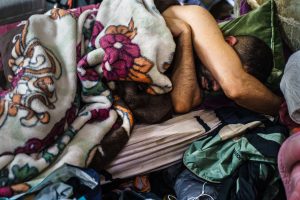
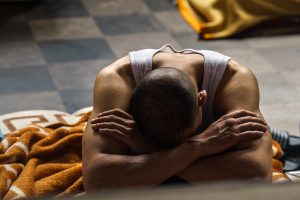
Face à ce mur du silence fédéral, le 23 mai, les occupants entament une grève de la faim qui durera deux mois. La ligne gouvernementale reste inchangée jusqu ‘à ce que le parti socialiste et écolo menacent de faire tomber la coalition gouvernementale dont ils font partie. Le secrétaire d’état, lui-même, cyniquement, né d’un père irakien réfugié, fait quelques infimes concessions du bout des lèvres. De critères clairs et objectifs, il n’est aucunement question. Au mieux, une promesse d’analyse objective des dossiers de régularisation sans embûches administratives.
C’était en juillet.
Début d’octobre, exception faite d’un dossier entamé avant la grève, aucun n’a encore obtenu de réponse. les règles administratives absurdes refont surface. Pire encore, un dossier a filtrer avec une note manuscrite du directeur de l’office des étrangers indiquant un refus. Il s’agit d’un dossier considéré par tous comme étant un dossier «témoin».
Face au silence à nouveau de mise tant au gouvernement que dans l’administration, les sans-papiers qui, pour la plupart ont perdu le peu qu’ils avaient à perdre, songent à reprendre la grève de la faim suspendue depuis le 21 juillet.
Chacun a le droit de mener une vie conforme à la dignité humaine.
A cette fin, la loi, le décret ou la règle visée à l’article 134 garantissent, en tenant compte des obligations correspondantes, les droits économiques, sociaux et culturels, et déterminent les conditions de leur exercice.
Ces droits comprennent notamment :
1° le droit au travail et au libre choix d’une activité professionnelle dans le cadre d’une politique générale de l’emploi, visant entre autres à assurer un niveau d’emploi aussi stable et élevé que possible, le droit à des conditions de travail et à une rémunération équitables, ainsi que le droit d’information, de consultation et de négociation collective;
2° le droit à la sécurité sociale, à la protection de la santé et à l’aide sociale, médicale et juridique;
3° le droit à un logement décent;
4° le droit à la protection d’un environnement sain;
5° le droit à l’épanouissement culturel et social;
6° le droit aux prestations familiales.
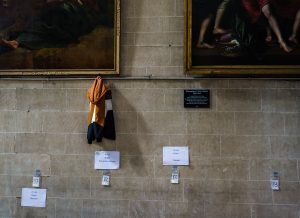
Conçue comme s’il s’agissait d’une collection muséale, l’exposition s’est déroulée en octobre 2021 alors que l’occupation était toujours en cours. Elle est visible en ligne ici.
L’entrée au musée national
Le musée selon wikipedia
Établissement dans lequel sont rassemblées et classées des collections d’objets d’intérêt historique, technique, scientifique, artistique, en vue de leur conservation et de leur présentation au public.
Le concept
La belgique est un état fédéral. Le concept de nation n’y trouve plus place. Sous cet angle, l’incapacité de nos gouvernements successifs à gérer la situation des étrangers sans titre de séjour valable sur le territoire fait sens. La belgique est un état dont les composantes n’ont plus de socle commun, l’histoire enseignée et la culture mise en avant dans chaque entité fédérée n’ayant plus aucun point de rencontre.
Face à cette situation schIzophrénique, les sans-papiers sont un constant défi pour notre état fédéral. Sur quelle base peut-on juger de l’ « intégration » d’un étranger en belgique? à quelle indentité culturelle doit-il faire allégeance? Quelle(s) langue(s) doit-il maitriser? les deux principales? ce faisant, il deviendrait alors un rappel permanent de l’échec de notre propre intégration fédérale. Un couteau dans une plaie qui ne fait que s’étendre et nous ronge.
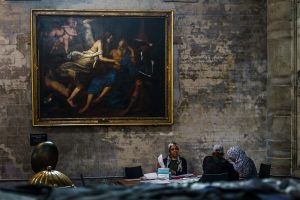
Ce musée national ne peut donc qu’être totalement imaginiaire, à la fois rappel nostalgique d’une grandeur passée imaginaire et rêve d’un futur où l’idée de belgique aurait encore (ou à nouveau) cours. Dans cette optique, l’entrée des sans-papiers et de leur lutte pour une vie décente fait doublement sens: d’une part, ils peuvent agir comme nouveau point de rencontre entre entités fédérées, servir de lien, faire pont. D’autre part, leur faire une place au coeur de ce musée est une manière concrète de reconnaître leur humanité car ils deviennent alors une partie de notre patrimoine commun tout en le révélant.
La photo, pour moi, tient à deux éléments essentiels : la lumière et les humains.
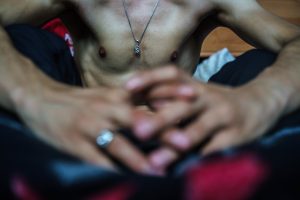
Je suis irrémédiablement attiré par les contrastes forts et j’ai tendance à chercher ce que l’on considère comme des complications, voir des erreurs tant en matière de lumière que de positionnement dans l’espace et de cadrage. Je me place naturellement en contre-jour, je cherche à couper l’avant-plan par des masses floues et je coupe les corps et les visages d’une manière assez radicale !
C’est plus qu’un effet de style, c’est ma manière de voir et de raconter le monde.
Cette manière de concevoir la photographie m’amène de plus en plus à me rapprocher des grands peintres classiques comme, par exemple, Il Caravagggio, Rembrandt ou Vermeer. Ce rapprochement avec la peinture est une évolution récente. Mes premières références se situaient entre de grands maîtres de la photographie et le cinéma de tous genres (j’ai fait des études de directeur photo à l’INSAS).
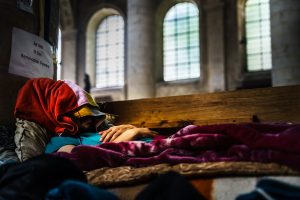
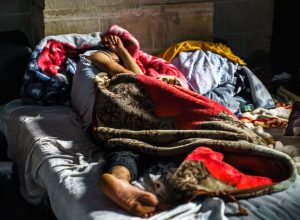
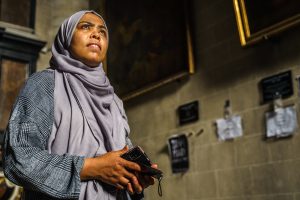
Pour assurer une cohérence visuelle forte lors de la sélection des clichés qui constituent ART. 23, je me suis tenu à la contrainte du lieu unique. une contrainte classique au théâtre (l’essence de la dramaturgie), Toutes les photos sélectionnées sont prises à l’intérieur de l’église. Et, en terme de lumière, je tenais à me cantonner, autant que possible, aux images de type clair-obscur.
De ces deux choix émane, je l’espère, un ton particulier, comme une sensation de précieuseté, comme si les pièces de l’exposition étaient des oeuvres issues des collections d’un musée. J’espère par cette approche, amener le spectateur à percevoir les personnes qui peuplent ces tableaux photographiques non plus comme des anomalies administratives mais bien comme des humains à part entière, un frère, une soeur, un parent, un ami cher.
C’est, en tout cas, ce que chacun d’eux est devenu pour moi au fil de ces mois passé à les immortaliser
Une grève de la faim.
Et nos illusions humanistes qui y prennent fin.
Près d’un demi millier de sans papiers en sont à une cinquantaine de jours de grève de la faim.
Un demi millier d’êtres humains.
Et pour quoi ?
Pour quel espoir fou ?
Celui d’obtenir le droit d’exister sur le sol Belge.
Qu’y a-t-il donc de fou à cette demande ?
L’église, la mort y rôde,
Notre honte s’y répand moite et humide,
Elle s’y enracine,
Elle nourrit l’hydre aux deux têtes, dorées et noires.
Positionnés au sommet d’un appareil d’Etat
Dévoré par le besoin de plaire… L’illusoire
Rongés par l’ivresse d’un certain pouvoir,
A l’abri du confort de bureaux sans âmes,
Celles-là même qu’ils ont perdues
Dans quelques campagnes éperdues,
Une meute d’assoiffés hétéroclites
Oublie la réalité… Une conséquence logique.
Nous avons laissé faire…
Et nous laissons encore faire…
Une responsabilité collective,
Symbolisée par une classe politique,
Qui n’a plus rien de classe,
Qui n’a plus rien de politique.
Aucun de ces privilégiés n’y aura mis
Ne fut-ce qu’un bout de mocassin verni,
Qu’ils réservent à quelques palais de marbre
Et de velour chatoyant, d’où, ils lanceront leur leçons
Dégoulinantes d’humanisme civilisé au reste du monde,
Du siècle des lumière,
N’a survécu que cette noire matière
Qui enrobe notre Univers.


copyright © 2024 Frederic Moreau de Bellaing